
The CAMS data - Copernicus Atmosphere Monitoring Service - are the cornerstone on which I focused the following analysis in which I focused on the PM10 trend in northern Italy from 2013 to March 2024.
Summary
The PM10 is unfortunately a pollutant known to almost everyone and I will not dwell on it. to talk about it.
I did the entire analysis using Python, I'll write as soon as I can. another article delving into the development aspects that allowed me to carry out the analysis.
But let's get back to the data. As I wrote above, I used the CAMS data, in particular the air quality reanalyses and the air quality forecasts. The former refer to a time window ranging from 2013 to 2022, they are divided on a monthly basis with hourly recording; there is therefore 24h coverage for every day of every month. They are revised by integrating data from the EEA - European Environment Agency - approximately twice a year for each new year published (the entire 2023 will therefore be available shortly). The latter, however, are data that cover a three-year moving window, in practice to date (date of publication of this article) it is possible to go back in time to April 2021. Both datasets have a spatial resolution of approximately 10km/px at our latitudes (0.1°) and an altimetric "resolution" ranging from 0 to 5,000m; However, they do not cover the entire column of air but they go by altitude steps. For this article I limited myself to the 0 meter altitude and used the data in Ensemble median Model for both datasets. PM10 is not however the only pollutant monitored is in fact, it is also possible to find PM2.5, O3 and other pollutants.
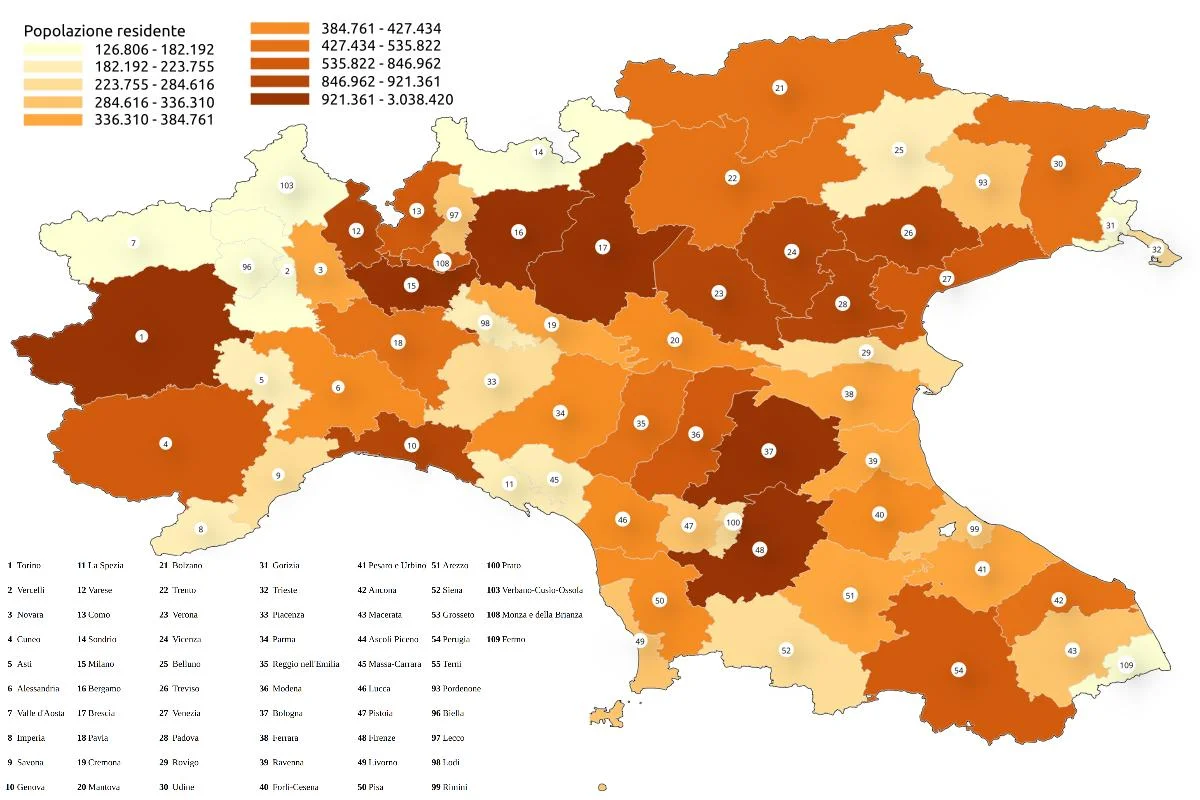
The focus is northern Italy and in particular the Po Valley, above all by virtue of of the alarming news from the end of February. The following map shows the total population by Province based on data from the 2011 complete population census.
Regulatory framework
The Legislative Decree 155/2010(and amendments to the Legislative Decree 250/2012), implementing the
The following limit values are then established for the pollutant in question (source: ARPA Toscana):
| Polluting | Limit | Mediation period | Limit | Exceedments in one year |
|---|---|---|---|---|
| PM10 (µg/m3) | 24-hour limit value for the protection of human health | Daily average | 50 µg/m3 | maximum 35 |
| Annual limit value for the protection of human health | calendar year | 40 µg/m3 |
Days of exceedance of the PM10 limit
The following image shows the days of annual exceeding of the limit imposed by the law.
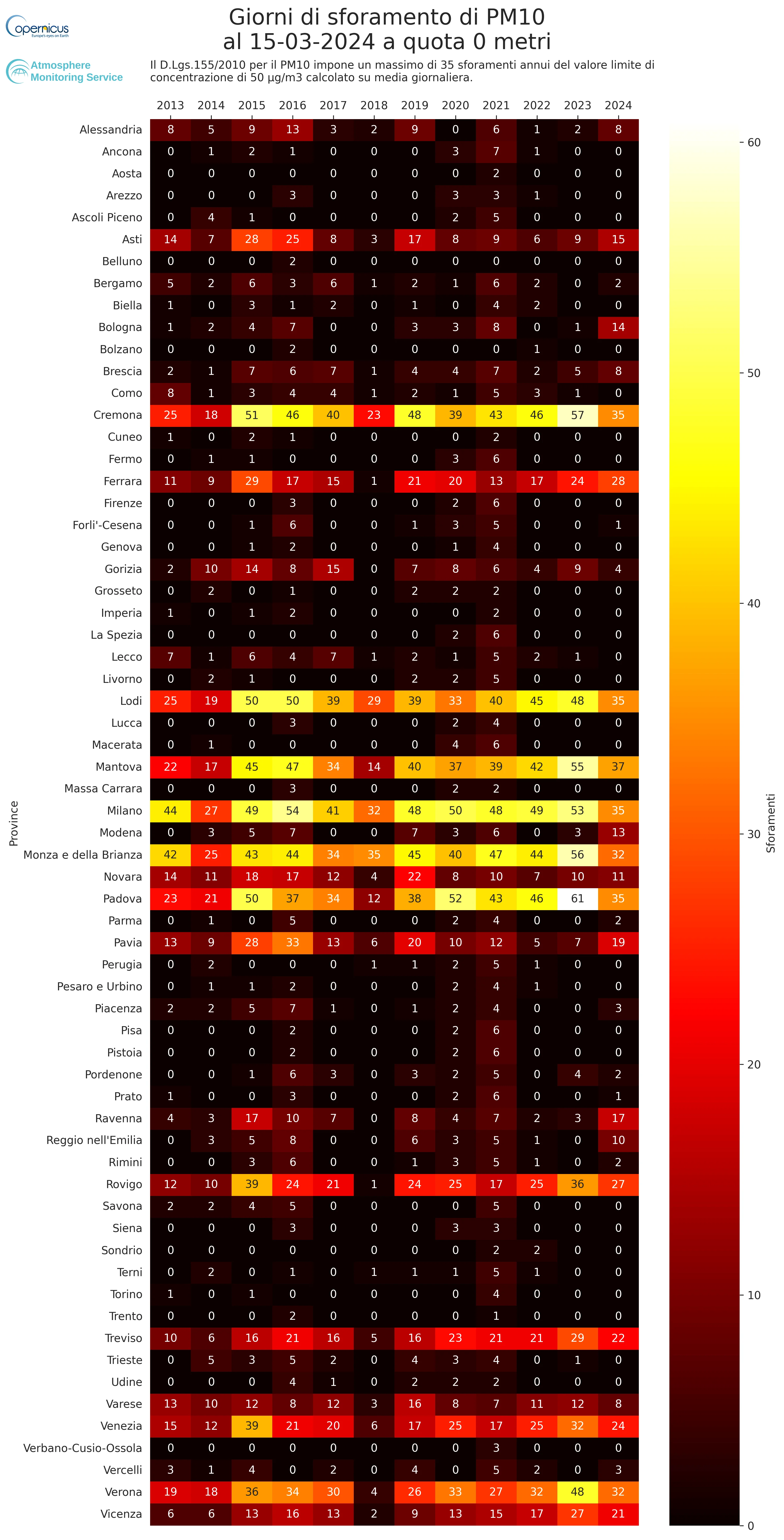
The provinces with the highest number of exceedances are those of Cremona, Lodi, Mantua, Milan, Monza and Brianza and Padua. These are areas which, unfortunately, have seen an increase in overruns from 2021 onwards (post lockdown) and it is possible to note a clear increase in overruns between 2022 and 2023. 2024 will probably also be a year with overruns given that in March almost all of them reached/overshot the limit. Also worth monitoring are the provinces of Rovigo and Verona which, although almost always remaining below the limit, saw an overshoot last year which will most likely be exceeded. confirmed at the end of this year.
Annual accumulation
When analyzing the data I asked myself what the annual accumulation of PM10 was and here too the data is not comforting.
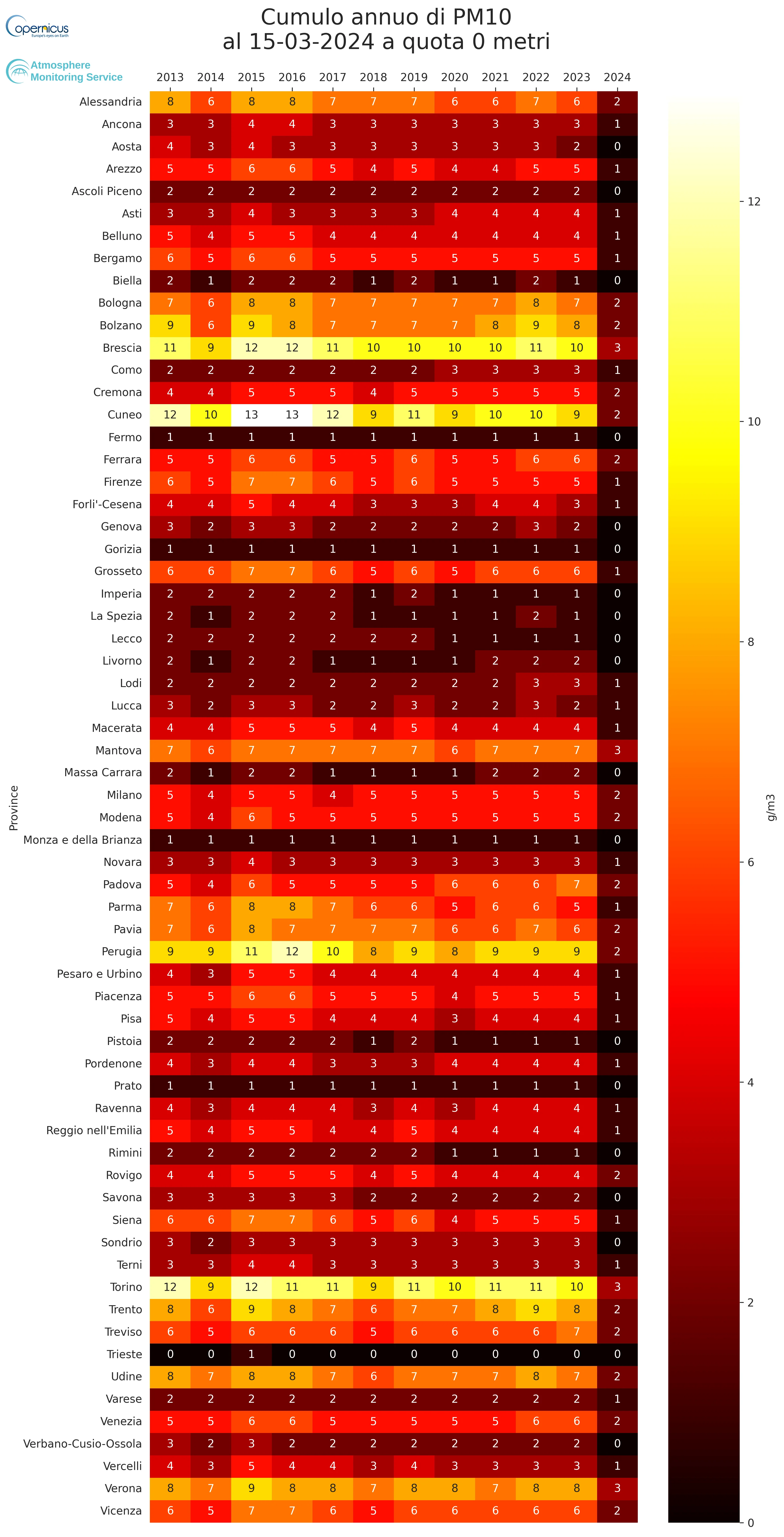
The largest cumulation is in the provinces of Brescia, Cuneo and Turin. I would have expected to find the same provinces as the overrun count.
Conclusions
Thanks to open data I was able to conduct this analysis, applause should be given to the Community Europea for its constant commitment to the program Copernicus.
I was very struck by the fact that it is really clear that from the post-lockdown for COVID to today the overruns have started to increase again and I find it equally interesting that the "affected" provinces are always the same since the beginning of the measurements, they are also the most populous among other things. In those territories, the policies relating to the management of pollutants should probably be reviewed; the presence of industries as well as vehicular traffic should also be analysed. Given the large presence of the population, I am led to think, however, that the primary culprits for these overruns are domestic heating and hot water production systems; a check should also be made in this sense having data available.
Why is it I also wanted to consider the accumulation of PM10? Lavoisier one day said: "In nature nothing is created, nothing is destroyed, everything is transformed". From the data analyzed, the provinces of Cuneo and Turin produced as many as 10 g/m3 of PM10 in 2023, but the pollutant is not that disappears, the count is not reset every year. Pretending that there is no circulation of currents, therefore let's pretend that the wind and all the other atmospheric factors that would allow a PM10 particle to move from the point of emanation do not exist, we would have that quantities of PM10 would constantly accumulate in the area that produced the pollutant. of the same which will go in part absorbed by plants in part, unfortunately, they will be absorbed in some way by the inhabitants. This last aspect is what is most I care. How much is public health spending for each g/m3 of PM10 absorbed by people?