
In major urban areas, approximately 2/3 of the victims of road accidents are made up of vulnerable users (pedestrians and cyclists) and motorbike drivers; from these data emerges a general picture of thedangerousness of the road environment in the city.
The 30 km/h zone strategy has proven to be one of the most effective measures for making mobility safer inside residential areas.
It appears under different names depending on the national context: it is sometimes described as a “traffic calming” policy, and sometimes as a set of measures to make residential traffic safer. In fact, the “30 zones” pursues the primary objective of the safety of the mobility space in urban residential areas.

Its purpose, however, is broader, because it also responds to the need for a more multifunctional urban street, which, with the spread of private motorisation, has ended up being used almost exclusively by cars. There is therefore a problem of rebalancing, within the mobility sector, between space dedicated to motorized traffic and space dedicated to pedestrian and cycling mobility and, within the motorized one, between space dedicated to public transport and space dedicated to private transport.
But the street, although it remains the domain of mobility functions, must also respond, especially within the residential space, to other functions, such as those typical of commerce, social interaction and meetings and, in more tranquil areas, it should also be able to accommodate children's play functions. Moreover, the fact that in all our cities there are large areas of the historic center affected by activities of tourist use, where intense motorized traffic creates clear environmental incompatibilities.
Roads in urban areas must bring benefits in safety, multifunctionality and quality environmental. The 30-zone strategy must be framed within a broader policy of improving the urban environment and its livability, on which motorized traffic has a decisive influence.
The first attempts at traffic calming were introduced in England starting from 1966: they consisted in the creation ofshared spaces, that is, of spaces shared between users, created by blindly closing some sections of the road and allowing the mixed transit of pedestrians, cyclists and motorized vehicles on the entire road surface. Theshared spacecan be considered the predecessor of the Dutchwoonerf, a space introduced for the first time in Holland in the Seventies, in the city of Delft, following the mobilization of a group of residents who wanted to reduce the constant accidents caused by cars.
In England, in more recent years, a new form of traffic calming has spread, replacing the experience of shared spaces with the Dutch woonerven model: these are home zones, residential streets that are often dead ends in which vehicles are forced to maintain very low speeds because of the physical layout of the road.
It is important to point out that neither woonerven nor home zones reduce vehicle access to homes or drastically cut residents' parking spaces: they introduce a different concept of road space within residential areas, still compatible with cars, but more effective when residents depend on them less.
These forms of sharing residential street space, which are also successfully spreading in many European cities, obviously cannot be considered solutions that can be generalized to the complex of residential streets. Therefore, in parallel with thewoonervenand thehome zonesother forms of traffic calming also spread, broader in scope and less intensive, with layouts closer to traditional roads and therefore less radical in the limits imposed on motorized traffic. These are precisely the "30 zones", which have taken on different names in various European countries: "30 zones" in Italy and France, “20 mph zones” in Great Britain, “time 30 zonen” in German-speaking countries.
The appearance of the road is not substantially modified, since the distinction between the pavements, intended for pedestrians, and the roadway, intended for vehicles, is maintained; furthermore, pedestrians do not have the right of way at every point on the road, but only at pedestrian crossings. The true conquest of the "30 zones" consists in the great increase in safety: vehicles are induced, by the shape of the road, not to exceed the speed limits of safety, which are sometimes even lower than 30 km/h.
In addition to increasing safety, the creation of the 30 zones constitutes an opportunity to redevelop street spaces, increasing the aesthetic value of the residential urban landscape.
The 30 zones have experienced widespread diffusion in Europe, becoming part of the transport legislation of many states: in Great Britain, for example, they were covered by theTraffic Calming Actof 1992, while in France they were introduced by decree no. 29 November 1990. 90/1060 “Amendments and additions to the French Highway Code”. In many states, the legislation provides for the possibility to establish a double regime in residential areas: the "30 zones", in which the streets maintain their traditional appearance but are treated with traffic calming techniques and thewoonervenorhome zones, equipped with a specific sign, in which the interventions are more intensive. In practice, however, there is often no continuity solution between zones 30 andwoonerven or home zones, but there are sets of streets with more moderate moderation measures. or less energetic.
As highlighted by Istat data (available on the website http://www.istat.it), the primary reason for the accident was road is represented by excess speed of motor vehicles: the accident occurs in that situation in which the driver is proceeding at a speed which does not allow him to stop the vehicle in time to avoid the impact, given the environmental situation of the road and the visibility of the road. that it allows in the various potential dangerous situations.
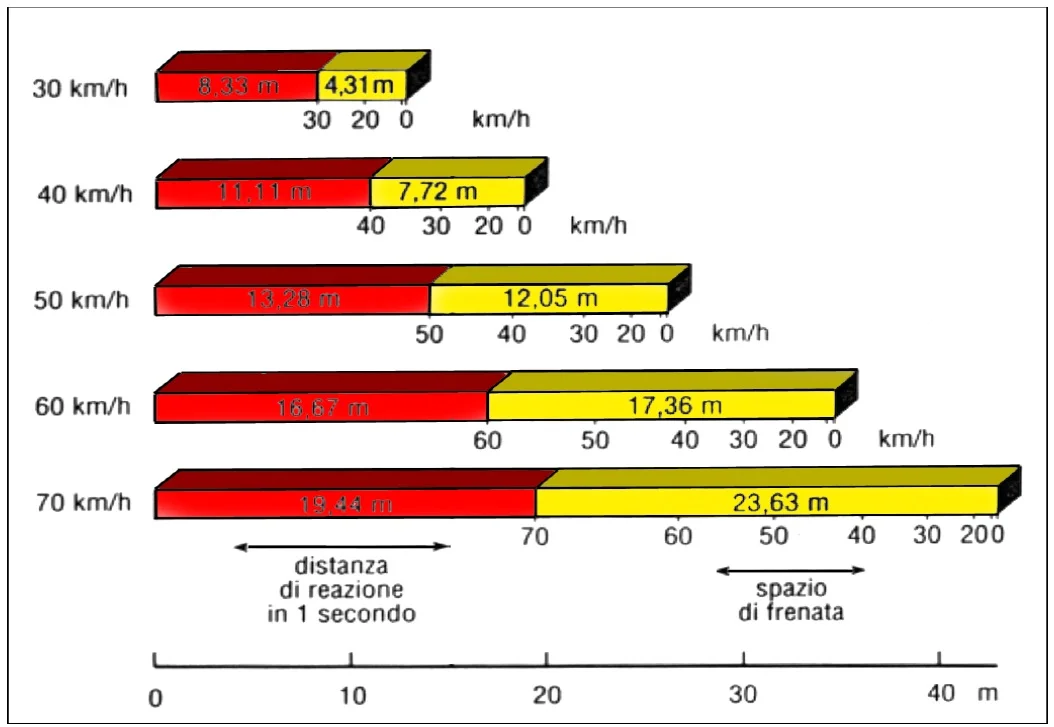
The speed safety is variable depending on the different situations offered by the road space and the way in which this is used. Traffic calming aims to ensure that the driver of a motor vehicle is induced to maintain the right speed in every situation. of safety. To achieve this result, the zone 30 strategy is based on two fundamental pillars:
- the redesign of streets.The traditional design of urban streets does not meet safety criteria; it must therefore be rethought, systematically adopting the technique of traffic calming measures. The reference model for this redesign is based on the principle of continuity of the network of sidewalks and cycle paths and the consequent discontinuity of the network of lanes intended for motorized traffic. So, at every intersection, it is not the pedestrian who "crosses the road", but is the driver of the motor vehicle that "crosses the pedestrian path (and the cycle path)". At every intersection or place of potential impact between pedestrian and vehicle, the road must be designed in such a way as to induce the driver of the vehicle to maintain a minimum speed. within the maximum safety margins. How can you understand, the road design technique of zone 30 requires particular expertise; but it requires, upstream, a change of vision of the problem of road space, which must no longer be seen from the perspective of the hurried motorist, but from that of the child who has a right to safety;
- the education of citizens. Even though the redesign of the road is expertly carried out, maintaining responsible driving behavior requires convinced adherence from the drivers of the vehicles. Therefore the road redesign action must be accompanied by an effective civic education action, which must be able to spread more sustainable driving behaviours. responsible. This educational action finds its maximum effectiveness precisely during the planning and implementation process of zone 30: the executive plan of zone 30 must also constitute a moment of effective public education, for which a specific action plan must be prepared with initiatives that last over time.
The mobility planning system urban planning in Italy exploits two main plan tools in which to insert the experience of the 30 zones:
- theurban traffic plan(PUT): a very short-term management plan (two years), mandatory for municipalities with more of 30,000 inhabitants or affected by particular tourist flows or commuting phenomena (the list of which is drawn up by the Regions). Established – although as a non-mandatory tool – with the circular of the Ministry of Public Works 8 August 1986, n. 2575, is became mandatory in 1992, with the approval of theNew Highway Code. TheNew Highway Codewas approved with Legislative Decree 285/1992 and is been modified more times, with subsequent decrees; the art. 36 of the code made urban traffic plans mandatory. TheNew Highway Codeis accompanied by theExecution and implementation regulation, contained in the Presidential Decree. 495/1992;
- theurban mobility plan(PUM): a medium-long term structural plan (ten years), for Municipalities or aggregations of Municipalities with several of 100,000 inhabitants, established – without obligation – by law 24 November 2000, n. 340. The same circular establishing the PUT, i.e. the n. 2575 of 1986, also introduced the transport plan, which however it is not was taken up by subsequent regulations and in fact had no concrete applications.
The single plan, which is has actually been tested in a widespread form, it is the PUT, for the obvious reason that it is It was the only instrument made mandatory by law: the PUM, in fact, was analyzed in the secondgeneral transport and logistics plan, adopted in 2001, which however did not have any legal value.