
Lately I have often seen recruitment posts on various social networks with apparently attractive pay and titles like the one I chose for this article.
A figure like 1,500€ per month these days is not bad, of course it always depends on where you live and if you have to move, but it's still an interesting figure.
If you read beyond the title, you nearly always find a note at the end, after the company profile and the description of the ideal candidate. It usually says: “the candidate is required to have a VAT number and be present on site."
Requesting a VAT number can make sense, because in general those who have one work as freelance professionals, whether or not they belong to a professional register. If on-site presence is required, however, then everything changes. Everything changes because the ideal candidate, freelance professional, is forced to be an employee, losing the only or one of the few advantages that life as a freelancer gives him: being able to organize his time based on the working method he has chosen. built over time.
Going beyond the purely ethical aspects, I want to focus on the economic aspect of this type of proposal. I will analyse the tax burden for a professional under the flat-rate regime. I chose this regime because it is usually the most convenient option if you do not have major deductible costs, and because it is the regime I know from direct experience.
Anyone considering a full-time offer that requires a VAT number should remember that there are only 12 monthly payments, with no paid holidays or sick leave. So €1,500 per month becomes €18,000 per year, the tax burden (I mean taxes plus contributions for brevity) varies depending on the profitability index which in turn varies depending on the ATECO code chosen when opening the VAT number. This index varies between 40% and 86% and affects turnover; this means that there are ATECO codes that apply a tax burden of 40% of the turnover and others that apply 86%. To make it even clearer, turnover is 100%, in the first case 40% of the same is taxed while in the second 86%. In this example I will take ATECO codes that fall into the “ Activitiesà category are taken into consideration professional, scientific, technical, healthcare, education, financial and insurance services" to which a profitability index is applied equal to 78%. I chose this macro-category because it includes my own activity as well as most technical profiles such as engineers, architects, surveyors, geologists, and similar professions.
Let's see how those €18,000 are distributed based on the reasoning above:
- Profitability index at 78%(G1): 3,960€ they are not taxed and are the first item of net profit, the remaining 14,040€ are subject to the following taxation;
- IRPEF 15%(A): 2,106€. It drops to 5% if the VAT number is opened for less than 5 years, but since it is not in my case I calculate on 15%;
- INPS 30%(B): 4,212€;
- Advance of taxation for the current year based on 90% of the taxation of the previous year(C): 6,318€(A+B, we are assuming that you are not in the first year of VAT number and that the only gain is that coming from the 1500€ per month) are the taxes to be paid for the previous fiscal year, 90% is equal to 5,686.20€;
- Taxes and contributions to be paid in the relevant fiscal year (A+B+C): 12,004.20€;
- Remaining untaxed turnover (G2): 2,035.80€, is the second item of net profit.
To summarize, on a turnover of 18,000€ the year, theamount of taxes and contributions equal to 12,004.20€ while thenet profit(G1+G2) is equal to 5,995.80 i.e. just under 500€ per month. Obviously the amount also varies depending on the social security fund to which you are connected. registered; I used the INPS example because it is the one I'm subscribed to.
Everyone can draw their own conclusions. Mine is that today it is impossible to live on €500 per month of net income. Do you need to buy a house? Assuming you find someone who agrees to take out a mortgage for you, then you have other expenses in addition to the tax ones to deduct from that 500€ per month; I then deliberately ignore all those arguments relating to bills, food and healthcare expenses that you would always have to face with that 500€ per month.
You will tell me: <<Yes, but the advance of 90% of taxes and contributions for the current year on the basis of the same ones from the previous year then, for better or worse, falls into the following years>>
It is partially true and depends on the cases and also there we are referring to an ideal situation. Let's pretend that for 6 years you always have this collaboration worth 18,000€ the year and everything proceeds normally.
In the following image there is the projection for the first six years of activity of a professional who has just opened the VAT number under the flat rate regime (the advance payment for Year 1 is null, I incorrectly counted it but it does not change the substance of the reasoning).

The next one shows the second six years of activity.
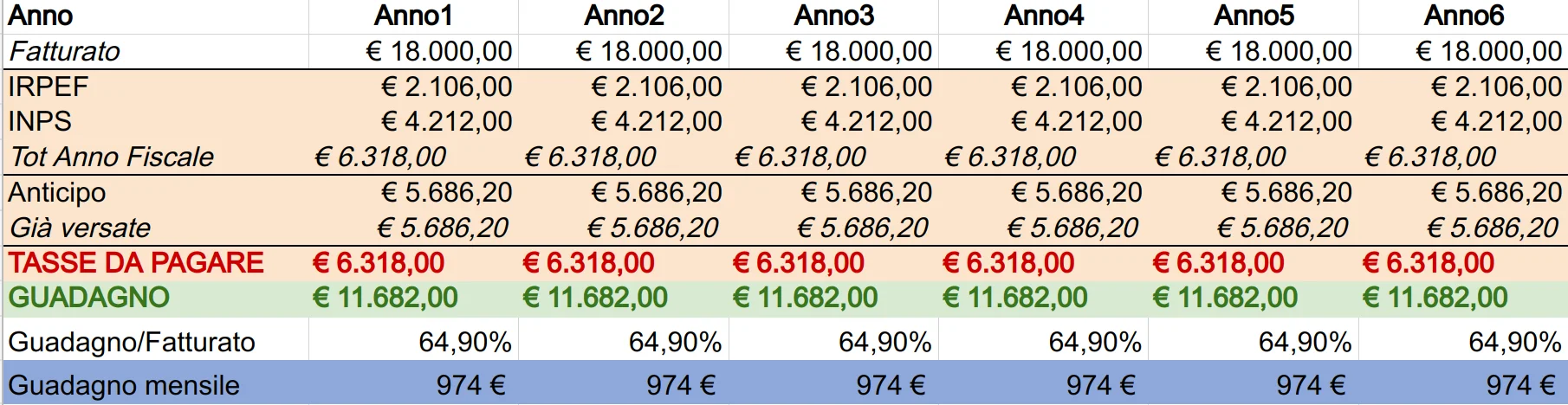
The projections show that in 12 years we will barely reach 1000€ net per month in an ideal situation where the annual turnover is constant. The classic situation that is often explained by many to justify that the advance is not a problem. Quite an unreal situation, because it is then we collide with reality and reality he says that between 2019(year in which I wrote this article) and 2023(year in which I updated it) we will experience a pandemic, the usual cyclical economic crisis, a war with serious economic repercussions on a global level. Factors that have a strong impact on both the consistency of collaborations and compliance with contracts. However, cyclical factors that can easily be found in previous years under different names. Factors which, to be clear, do not allow you to say that next year I will earn more. total.
Below is It is possible to see the survival expectancy of a person entering the profession today with his first six years of activity.

And maybe the next six, if he gets there.
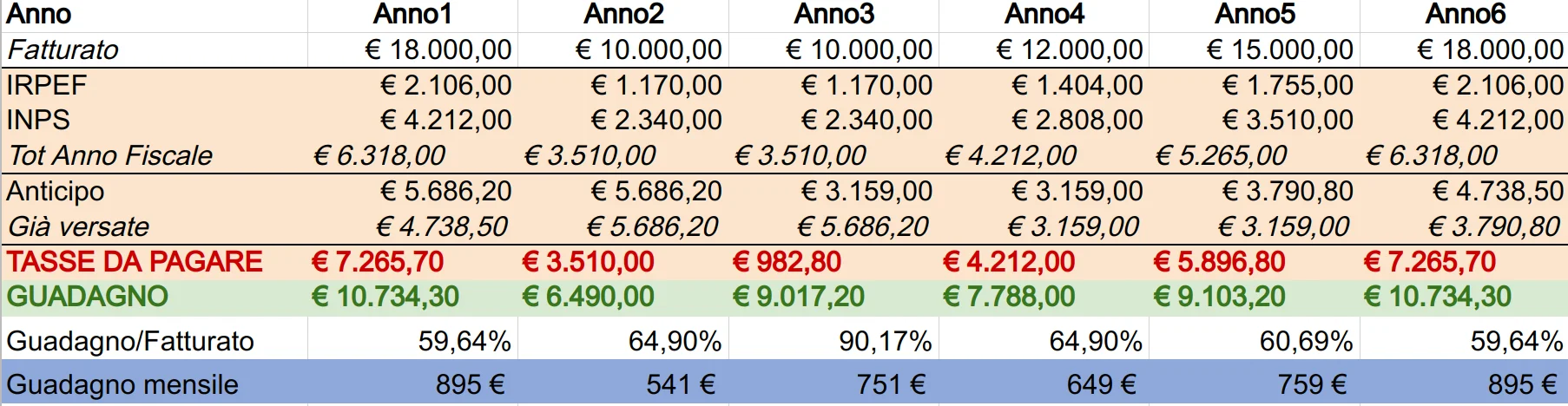
The numbers are quite merciless. It follows that "the bar that has been lowered" today, makes the situation even more serious yesterday.
Whoever proposes such solutions, I don't know if they have a clear idea of what they are proposing in order not to bear the costs necessary to hire a person with a regular contract for 1500€ per month gross, which net on average would be 1,200€ as an employee. On the other hand, the entrepreneur on duty could answer that hiring a person for 1,500€ per month is equivalent to a business cost of at least 3,000€ per month. It's probably like this, but if you want to offload the business risk (yours) onto me, who am a freelancer, it means that you are looking for a partner and not a collaborator; then there things change, give me part of the shares or close.
Closing today, February 4, 2023, a decent annual billing for a freelancer cannot be achieved. fall below 30,000€ per year, a figure which entails approximately 1,500€ net per month.